Florida Property Tax Changes: What Homeowners & Buyers Need to Know
Florida voters approved Amendment 3 on November 3, 2026. Here’s how the new homestead exemption works for Sarasota, Lakewood Ranch, Bradenton, Venice, and other Florida communities.
Approved November 3, 2026 · Effective January 1, 2027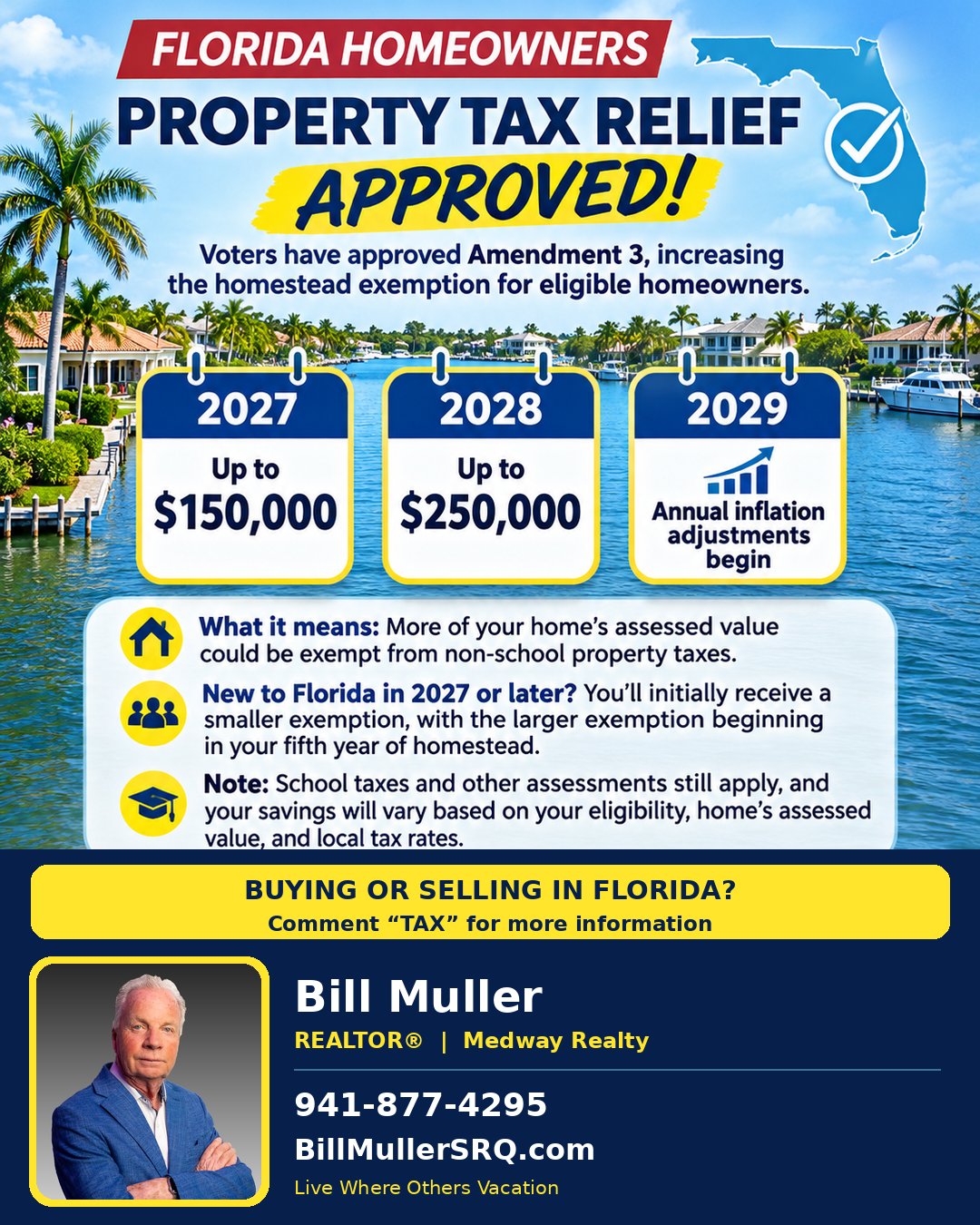
The new homestead exemption at a glance
Amendment 3 increases the portion of a qualifying primary residence’s assessed value exempt from non-school property taxes. These are exemption amounts, not cash rebates or guaranteed reductions to your tax bill.
Who qualifies for the larger exemption?
If you are a Florida resident by December 31, 2026: The larger exemption can apply when you own a qualifying Florida homestead and meet the legal requirements. You do not need to purchase a home by December 31, 2026 just to preserve eligibility based on that residency date.
If you become a Florida resident in 2027 or later: The amendment provides for the existing exemption when you first qualify for homestead and the increased exemption beginning in your fifth year of homestead exemption, to the extent permitted by the U.S. Constitution.
Homestead generally applies to your permanent primary residence, not a vacation home or rental property. Application and eligibility decisions are handled by the county property appraiser.
What property taxes will you still pay?
- School district property taxes are not reduced by the expanded non-school exemption.
- Non-ad valorem assessments and fees such as certain solid-waste, stormwater, or service assessments may remain on your bill.
- Actual savings vary with assessed value, exemptions, taxing districts, millage rates and other factors.
The changes first affect 2027 property tax bills, typically issued in November 2027. Your 2026 tax bill does not change because of this amendment.
What if you are buying a home in Sarasota or Lakewood Ranch?
Do not estimate your future property taxes simply by copying the seller’s current bill. Florida’s Save Our Homes assessment cap, portability, purchase price, location and homestead eligibility can all change a new owner’s bill.
Ask the appropriate county property appraiser about your eligibility, and use its tax-estimation tools as a starting point. Existing estimator calculators may not yet reflect the new 2027 rules.
What about second homes and investment properties?
The increased homestead exemption does not apply to second homes or rentals. Amendment 3 separately reduces the annual cap on assessment increases for qualifying non-homestead property from 10% to 5%. That cap concerns assessment increases, not a guaranteed annual property tax reduction.
Florida homestead exemption FAQs
How much is the homestead exemption in 2027?
Up to $150,000 of assessed value may be exempt from non-school property taxes for eligible homesteaded properties. This is not a $150,000 payment or a $150,000 tax bill reduction.
What changes in 2028 and 2029?
The non-school tax exemption increases to up to $250,000 in 2028, with annual inflation adjustments to the maximum beginning in 2029.
Do I need to buy a Florida home before December 31, 2026?
No. That date concerns residency, not a required home-purchase deadline. You must still own a qualifying primary residence and meet the applicable homestead requirements when you claim the exemption.
What if I move to Florida after December 31, 2026?
You may initially receive the existing homestead exemption once qualified. Under the amendment, the larger exemption begins in the fifth year of homestead exemption, to the extent permitted by the U.S. Constitution.
Does Amendment 3 eliminate property taxes?
No. School property taxes and other assessments can still apply, and local tax rates may change.
Buying, selling, or moving to Florida?
Let’s look at the full cost of your next move, including property taxes, insurance, HOA costs and the right neighborhood for your goals.
Information updated November 5, 2026. This page is a general real estate education resource, not legal or tax advice. Statutory implementation, constitutional limitations, local tax rates and individual eligibility can change the result. Confirm your exemption and estimate with your county property appraiser and a qualified tax professional as needed. Sources: Florida Department of State, Sarasota County Tax Collector, Sarasota County Property Appraiser, and Manatee County Property Appraiser.